
Our work

Publications & evidence.

Verifiable work builds trust. Below is a selection of our published research, national evaluations and policy contributions — each independently citable.

Peer-Reviewed Research

The impacts of task shifting on the management and treatment of malnourished children in Northern Kenya: a cluster-randomized controlled trial

Donfouet, H. P. P., Daniel, T., Wilunda, C., Mwaniki, E., Njiru, J., Zerfu, T. A., et al. (2024). Health Policy and Planning, 39(7), 710–721.

A cluster-randomized controlled trial across 20 community health units in Loima and Isiolo counties, testing whether community health volunteers could safely treat uncomplicated acute malnutrition at home — improving recovery rates and reducing defaulting.

Read on Health Policy and Planning
Peer-Reviewed Research

Treatment of moderate acute malnutrition through community health volunteers is a cost-effective intervention: evidence from a resource-limited setting

Maternal & Child Nutrition (2024), 20(4), e13695.

Economic evaluation evidence showing that shifting treatment of moderate acute malnutrition to community health volunteers is cost-effective — strengthening the case for community-level management of malnutrition in resource-limited settings.

Read on Maternal & Child Nutrition
National Evaluation

Baseline Evaluation of the WFP Kenya Country Strategic Plan (2023–2027)

Delivered with Mokoro Ltd for the World Food Programme Kenya Country Office.

A theory-based, mixed-methods baseline for WFP Kenya's Country Strategic Plan — including a large-scale household survey of 10,494 households across diverse counties, key informant interviews, focus groups and a co-creation workshop with the WFP country office.

View project at Mokoro
Policy Contribution

National Guideline for Integrated Management of Acute Malnutrition (IMAM)

Ministry of Health, Republic of Kenya (2021).

Contribution to Kenya's national guideline governing the assessment and management of acute malnutrition — the protocol that shapes how frontline health workers treat malnourished children across the country.

Kenya MoH Nutrition & Dietetics resources

Why it matters

Evidence that reaches policy.

Research only matters if it changes something. Our work has shaped national guidelines, informed UN agency strategy, and demonstrated — in peer-reviewed journals — that community-level approaches to malnutrition treatment work and are cost-effective.

That's the standard we bring to every assignment: rigorous methods, transparent findings, and results that decision-makers can act on.

Commission research or evaluation
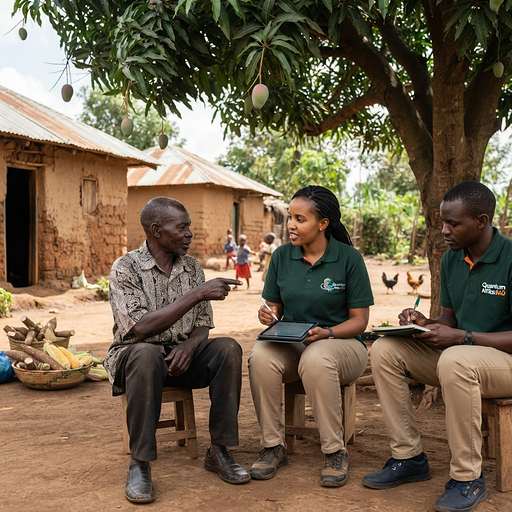
A field researcher interviewing a household during an evaluation survey